


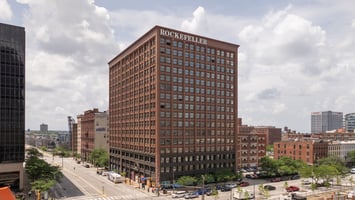






Highly Incentivized Historical Redevelopment
Over $24 Million In Incentives Secured
Marketing description
A LANDMARK REIMAGINED
The Rockefeller Building presents a rare chance to acquire and transform one of Downtown Cleveland’s
most iconic historic assets. Situated on 1.85 acres at the gateway to the Warehouse District, this
304,586 SF building has reached the end of its office lifecycle but is primed for redevelopment
into residential or mixed-use. Surrounded by major investment and downtown vibrancy, this site is
ideally located to support premium market-rate apartments, ground-floor activation, and innovative
development on excess land.
FLEXIBLE REDEVELOPMENT PATHS
Multiple approaches have been studied to maximize the site’s potential, including:
• 237 to 436 residential units
• Activated ground-floor retail, coworking, or amenity space
• Excess land for:
- Surface parking (currently 180 spaces)
- New parking structure
- Vertical infill development
LOCATION ADVANTAGE
The Rockefeller Building is located in one of the most walkable and transit-connected areas of
downtown Cleveland. It sits adjacent to the new $1 billion Sherwin-Williams Global Headquarters,
slated for completion in Q3 2025, placing it in prime position to capture top-tier residential demand
and premium rents.
PREMIER LOCATION & TRANSFORMATIVE NEIGHBOR
The site’s walkability, transit access, and proximity to Cleveland’s top downtown amenities are
unmatched. Most notably, the building sits next door to the $1 billion Sherwin-Williams Global
Headquarters, slated to open in Q3 2025—a transformational investment that will anchor tenant
demand for years to come.
OFFERING DETAILS
• Call for Offers: September 15, 2025 (Early submissions encouraged)
• Process: Seller is seeking an efficient transaction with a focused due diligence period.
Investment highlights
SUMMARY OF INCENTIVES
FEDERAL HISTORIC TAX CREDIT:
The Federal Historic Tax Credit (HTC) program provides developers with a 20% federal tax credit on
qualifying rehabilitation expenses for income-producing historic properties. To be eligible, projects
must meet the Secretary of the Interior’s Standards for Rehabilitation and gain approval through
the National Park Service (NPS). Several notable Cleveland projects have successfully utilized these
credits, including The 9, Terminal Tower, and the May Company Building, demonstrating their local
impact and viability. Previous redevelopment proposals for Cleveland’s iconic Rockefeller Building
estimated potential historic tax credits exceeding $14 million, highlighting the substantial financial
advantage these credits offer. Leveraging the HTC program can significantly reduce redevelopment
costs, making ambitious historic renovation projects financially feasible.
STATE HISTORIC TAX CREDIT:
The Ohio Historic Preservation Tax Credit program offers an additional 25% tax credit on qualified
rehabilitation expenditures (QREs) for historic buildings, including both income-producing and
owner-occupied properties. Administered by the Ohio Department of Development, the program
is competitive and capped at $60 million in credits annually. Rehabilitation work must comply with
the Secretary of the Interior’s Standards and exceed the building’s adjusted basis. Based on prior
redevelopment proposals, the Rockefeller Building was estimated to be eligible for over $4 million
in state historic tax credits. These credits are transferable and have fueled over $4 billion in private
investment across Ohio since 2007, making them a powerful tool for developers seeking to revitalize
historic assets.
FEDERAL OPPORTUNITY ZONE AND OHIO FUND TAX CREDIT:
Federal Opportunity Zone tax advantages allow investors to defer, reduce, or potentially eliminate
capital gains taxes by investing in designated economically distressed areas, promoting long-term
economic growth. The Ohio Opportunity Zone Tax Credit Program provides a 10% non-refundable
tax credit to investors who invest in projects located within designated Ohio Opportunity Zones
through a Qualified Opportunity Fund (QOF). Investors must be subject to Ohio income tax and can
earn tax credits equal to 10% of their investment into eligible Opportunity Zone properties. These
credits are transferable, allowing for additional flexibility and liquidity, and are capped at $2 million
per investor during each biennium. In a prior redevelopment proposal, the Rockefeller Building was
estimated to qualify for approximately $2.4 million in Ohio Opportunity Zone tax credits, further
strengthening the financial feasibility of a redevelopment project at the site.
THE OHIO CONSERVATION EASEMENT PROGRAM:
The Ohio Conservation Easement Program allows property owners to place permanent restrictions
on their property to preserve its historic, scenic, or open-space value. By donating a conservation
easement, owners may be eligible for federal income tax deductions and potential reductions in local
property taxes. Given the Rockefeller Building’s historic designation and architectural significance,
it qualifies for such an easement. Implementing a conservation easement would ensure long-term
preservation of the building’s façade and structure while offering developers or owners valuable
financial incentives as part of a broader redevelopment strategy.
OHIO BROWNFIELD FUND:
The Ohio Brownfield Remediation Program offers grant funding to support the cleanup and
redevelopment of contaminated commercial and industrial sites. Eligible activities include
environmental remediation, asbestos abatement, and demolition. The Rockefeller Building has
been awarded an estimated $7.3 million through this program to assist with remediation and site
preparation, providing a critical boost to the project’s overall feasibility.
Listing Contacts
Valuation Calculator
Valuation Metrics
Broker Selected Comps View More Comps
Property History

Similar Properties
Is there information that looks off?
